
How to Stop Black and Dark Packaging Boxes Scuffing and Scratching in Transit
Quick answer
Black and dark boxes show scuffs because any rubbing changes the surface sheen or exposes lighter fibres, and the contrast is high. The two biggest levers are the finish and the packing. For matte black, an anti-scratch (anti-scuff) matte film is commonly the first option to consider, while plain matte film, soft-touch and varnish usually mark more easily. Then stop boxes rubbing against each other in the carton with sleeves, polybags or interleaving sheets and tight packing. Approve the combination with a rub test on the real finish and a shipped test carton, because no finish is completely scratch-proof.
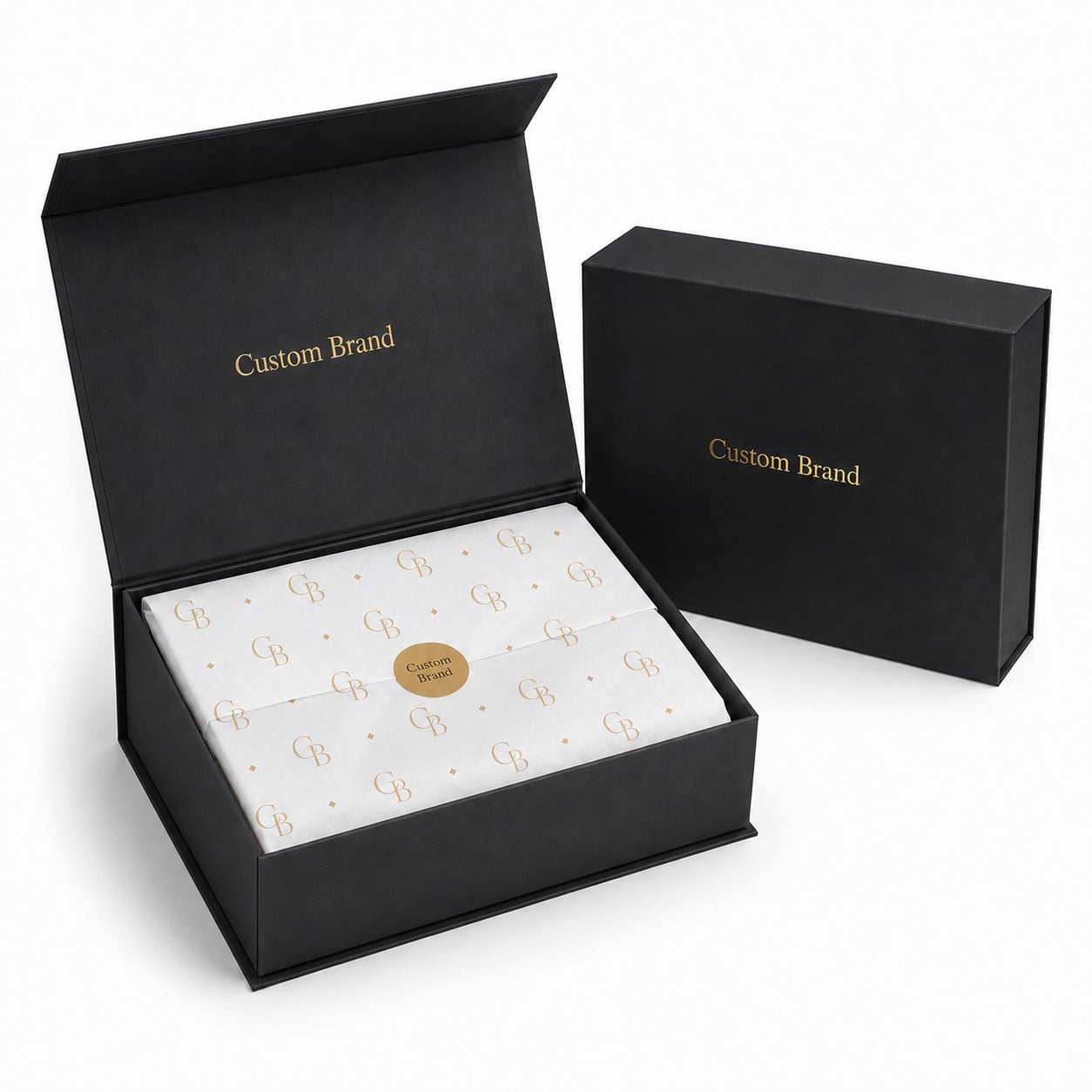
Quick facts: Custom Black Magnetic Gift Boxes with Branded Tissue Paper
- Indicative unit price: from about US$0.50 per box. This is a guide, not a quotation: the final price depends on size, material, print colours, finish and order quantity.
- MOQ: typically from 500 pcs per size and artwork; the confirmed minimum depends on material, print method and features and is stated on the quotation.
- Lead time: Physical samples 5–7 working days after artwork is confirmed; bulk production 20–30 days after sample approval.
- Who makes it: BestPackFactory’s own factory in Longhua District, Shenzhen, China. Free dieline and artwork proof within 24 hours. See real samples and videos.
- Specifications and quote: Custom Black Magnetic Gift Boxes with Branded Tissue Paper · Request a quote
Know which mark you are fighting
“Scuff” covers several different marks, and each has its own fix. Look closely at a damaged box before choosing a solution.
| Mark | What it is | Usual cause | Main fix |
|---|---|---|---|
| Shiny rub patches on matte | The matte surface is polished smoother (burnished) | Box faces rubbing during transport | Anti-scratch matte film; stop movement |
| Fine lines or scratches | The film or coating is cut | Grit, corrugated dust, sharp edges, product parts | Harder surface finish; separation sheets |
| Light or white marks on corners and edges | Printed ink or paper fibres are worn through | Corner impacts; printed black on white paper | Dyed-through black paper or better corner protection |
| Grey or brown transfer marks | Material picked up from another surface | Contact with corrugated board, rubber or tape | Inner wrap or polybag; clean packing area |
| Fingerprints and greasy patches | Oils from handling | Bare-hand packing; soft-touch surfaces | Glove packing; finish choice |
Finish options on solid black
| Finish | Look | Scuff behaviour (typical) | Watch points |
|---|---|---|---|
| Anti-scratch matte film | Matte, similar to standard matte | Usually resists rub marks better than standard matte | Not scratch-proof; costs more, confirmed in the quotation |
| Standard matte film | Soft matte | Often shows shiny burnish marks on large black areas | Fine for small dark areas or well-protected boxes |
| Soft-touch film or coating | Velvety, deep black | Results vary; many products show fingerprints and rub marks | Test the exact product; see the soft-touch guide |
| Gloss film | Shiny, rich black | Hides burnishing, but fine scratches can be visible | Changes the brand look; reflections |
| Varnish or water-based coating only | Depends on coating | Usually the least protection on large black solids | Ink can wear off on corners |
| Dyed-through black specialty paper (rigid wraps) | Colour through the fibre, often textured | Edge wear shows less white; texture can hide light marks | Can still polish shiny; test the chosen paper |
These are typical tendencies, not guarantees. Film brand, adhesive, ink, board and handling all change the result, and suppliers do not always agree on how soft-touch compares with standard matte. Test the exact combination.
Packing that prevents scuffs
- Separate decorated faces. Use tissue, a non-woven or paper sleeve, a polybag or an interleaving sheet so box faces do not rub together.
- Remove movement. Fill master cartons fully, use layer pads, and avoid loose space that lets boxes slide during transport.
- Keep corrugated off the print. Raw corrugated surfaces and dust are abrasive on black films.
- Protect corners. Corner impacts cause most white edge marks. Use layer pads, correct carton sizing and careful strapping.
- Pack cleanly. Gloves and a clean, dust-free packing table reduce fingerprints and grit scratches.
- Think about the product too. Bottles and accessories moving inside the box can mark it from the inside; fit is covered in the insert fit guide.
Decision rules
- Choose anti-scratch matte film when a box has large matte black areas and travels through courier, e-commerce or long export routes.
- Choose soft-touch on black mainly when the box is protected by an outer sleeve, mailer or polybag and your rub test passes.
- Choose dyed-through black paper for rigid boxes where white edges and corners are the main complaint.
- Choose gloss only if the brand look allows it and fine scratches are acceptable.
- Add individual protection whenever boxes are retail-ready on arrival and cannot be wiped or replaced.
Run a rub test before approval
Laboratories commonly use a Sutherland-type rub tester, described in ASTM D5264, which rubs a printed sample against another surface under a set weight for a set number of strokes. Without a tester, a simple in-house version still helps: rub the finished box face against another box, or against a piece of corrugated board, under light even pressure for an agreed number of strokes, and compare finishes side by side. Then pack a full master carton the way production will be packed and send it through your real courier or freight route. Keep the tested samples as the agreed reference for bulk.
What to put in the RFQ
- Exact finish name, for example “anti-scratch matte film” rather than “matte”
- How the black is made: printed black on white paper, or dyed-through black paper
- Extra finishes on top, such as foil or spot UV, which can also scratch
- Individual protection, carton quantity, layer pads and pallet requirements
- Shipping route and whether boxes go straight to customers
- The rub test method and the reference sample for approval
Common mistakes
- Choosing a finish from a flat swatch that never went through shipping.
- Packing black boxes face to face with no separation.
- Loose cartons that allow boxes to slide during transit.
- Expecting any film to be completely scratch-proof.
- Packing with bare hands on soft-touch or black matte surfaces.
Frequently asked questions
Is soft-touch or anti-scratch film better for black boxes?
For large black areas that travel through courier or export shipping, anti-scratch matte film is commonly the safer first choice because it is designed to resist rub marks. Soft-touch gives a deeper feel but results vary, so test both on the real box before deciding.
Is any packaging finish completely scratch-proof?
No. Anti-scratch films and coatings reduce visible marks, but grit, sharp edges and heavy rubbing can still mark any surface. Packing that stops boxes rubbing is just as important as the finish.
Can scuff marks on matte black boxes be cleaned off?
Shiny burnish marks on matte film usually cannot be removed because the surface itself has changed. Some transfer marks and fingerprints can be lifted gently with a dry microfibre cloth, but test on a spare box first.
Related pages
Prepare a quote-ready packaging brief
Send box style and size, the finish you are considering, how the black is made, packing requirements, quantity and shipping route. BestPackFactory makes every product in its own factory, with a minimum order of 500 PCS. Send your brief through the contact page, WhatsApp +86 158 8653 0985 or lisa@colorprintingpackage.com; the final specification and test method are confirmed in the quotation.
Request a project quote