
PETG vs PVC vs OPS Shrink Sleeves: Choosing the Film and Designing for Distortion
Quick answer
Work out how much the sleeve must shrink, then choose the film. PETG commonly offers the highest transverse shrink, often around 70–78%, and suits strongly contoured bottles. PVC typically shrinks around 50–60%, is forgiving in the shrink tunnel and suits gentler shapes, but some markets and brands avoid it. OPS sits roughly in between, shrinks at lower temperatures with gentle force, but needs cool storage. Artwork must be pre-distorted for the container so text and barcodes look right after shrinking; confirm on a shrunk sample.
Quick facts: Custom Shrink Sleeve Labels for Cans & Bottles
- Indicative unit price: about US$0.05–0.10 per piece. This is a guide, not a quotation: the final price depends on size, material, print colours, finish and order quantity.
- MOQ: typically from 500 pcs per size and artwork; the confirmed minimum depends on material, print method and features and is stated on the quotation.
- Lead time: Physical samples 5–7 working days after artwork is confirmed; bulk production 20–30 days after sample approval.
- Who makes it: BestPackFactory’s own factory in Longhua District, Shenzhen, China. Free dieline and artwork proof within 24 hours. See real samples and videos.
- Specifications and quote: Custom Shrink Sleeve Labels for Cans & Bottles · Request a quote
What this guide covers
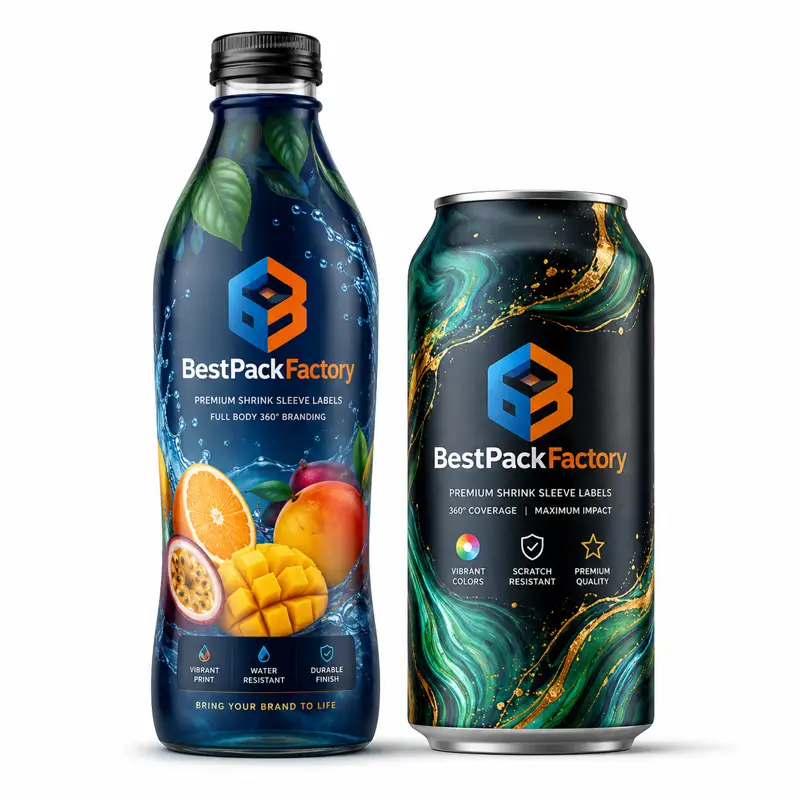
A shrink sleeve is a printed tube of film that is placed over a container and heated so it shrinks to the shape. It can cover the whole bottle, including the cap, and decorate curves a pressure-sensitive label cannot. Our label printing guide covers pressure-sensitive labels; this article covers two questions specific to sleeves: which film to use, and how to design the artwork so it survives shrinking.
Step 1: calculate the shrink you need
Measure the container at its widest point the sleeve must slip over and at its narrowest point the sleeve must grip, such as the neck. Then:
Required shrink (%) = (1 − narrowest circumference ÷ widest circumference) × 100
Add a margin, commonly a few percent, for the sleeve lay-flat being slightly larger than the container and for variation in the tunnel. Compare the result with the usable shrink of each film, not the maximum on the datasheet. If the required figure is near a film’s limit, the narrow area is likely to show wrinkles, thin spots or poor graphics.
PETG, PVC and OPS compared
Figures are typical market ranges for transverse-direction shrink and vary by grade and supplier. Ask for the shrink curve of the exact film quoted and test it in your tunnel.
| Property | PETG | PVC | OPS |
|---|---|---|---|
| Typical maximum shrink | about 70–78% | about 50–60% | about 60–70% |
| Best for | Strong contours, full-body and neck sleeves | Moderate curves, cost-sensitive runs | Contoured shapes needing gentle shrink |
| Shrink behaviour | High shrink force; can shrink quickly, so tunnel control matters | Gradual, forgiving shrink | Shrinks at lower temperatures with low force |
| Storage | Keep cool; some shrink before use if stored warm | Low natural shrink at normal warehouse temperatures | Highest sensitivity to heat in storage and transit |
| Thin or flexible containers | High force can deform them | Gentler | Gentle |
| Other notes | Widely used where brands avoid PVC | Some retailers, brands and markets restrict PVC | Can be more brittle; check handling |
Decision rules
- Required shrink above about 60%: PETG is usually the first choice; some OPS grades may work.
- Required shrink below about 50% and a simple shape: PVC or a standard PETG grade both work; choose on cost, market rules and brand policy.
- Thin-walled, empty or hot-filled containers: favour lower shrink force (OPS or PVC) or a lower-force PETG grade, and test.
- Warm supply chain or long storage: avoid OPS unless storage can be kept cool; ask for storage limits for every film.
- Recycling goals: ask how the sleeve affects recycling of your container, and consider a perforation so consumers can remove it.
Step 2: design artwork for shrink distortion
The film shrinks most where the container is narrowest, so flat artwork changes shape after shrinking. A circle printed on the neck area becomes an oval; text there gets compressed. The usual method is:
- Print a grid of squares on the chosen film and shrink it onto the real container.
- Measure how each square changes, row by row, to build a distortion map.
- Pre-distort the artwork in the opposite direction so it looks correct after shrinking.
- Print a proof sleeve with the distorted artwork, shrink it and check.
Practical rules: keep logos, nutrition panels, small text and barcodes on the straight body. Use patterns, colour fields or simple graphics in high-shrink zones like the neck and shoulder. Leave room at the seam, where the film overlaps and is bonded, and avoid fine detail across it. Remember that sleeves are reverse printed on the inside of the film, and white backing is often needed behind colours on clear or coloured bottles.
Barcodes on sleeves
Put the barcode on the least-shrunk area, typically the main body, and orient bars so the direction of greatest shrink does not squeeze the bar widths unevenly. Always verify scanning on a shrunk sample, not on the flat proof.
What to send in your RFQ
- Container drawing with dimensions, or physical samples; note whether the container is filled when sleeved.
- Coverage: full body, partial, with cap or neck band, and any tamper-evident perforation.
- Application method (manual or automatic) and roll requirements: core, outer diameter, unwind direction.
- Shrink tunnel type (steam or hot air) if known.
- Film preference or restrictions, thickness if specified, and recycling goals.
- Artwork status and whether distortion is to be done by your designer or by the printer.
- Quantity per design and destination.
Common mistakes
- Choosing a film from its maximum shrink figure instead of the usable range.
- Sending flat artwork without a distortion step.
- Placing a barcode or legal text over the shoulder or neck.
- Storing OPS or PETG sleeves in a hot container or warehouse before use.
- Skipping a tunnel trial on the real container.
Frequently asked questions
Which shrink sleeve film shrinks the most?
PETG generally offers the highest transverse shrink of the three, often quoted around 70–78% depending on grade. OPS is commonly in the 60–70% range and PVC around 50–60%. Confirm the exact curve on the datasheet for the grade quoted.
How do I calculate the shrink a sleeve needs?
Divide the smallest circumference the sleeve must grip by the largest circumference it must pass over, subtract the result from 1 and express it as a percentage. Add a margin of a few percent and compare that with the usable shrink of the film.
Why does shrink sleeve artwork need distortion?
The film shrinks more where the container is narrow, so flat artwork stretches or squeezes after shrinking. A distortion grid printed and shrunk on the real container shows how to pre-distort text, logos and barcodes.
Where should a barcode go on a shrink sleeve?
Place it on the straightest, least-shrunk area of the container, usually the main body, with bars running in the direction that shrinks least. Verify scanning on a shrunk sample.
What is the MOQ for custom shrink sleeve labels?
At BestPackFactory the MOQ is 500 PCS per design. Film, thickness and cost for your container are confirmed in the quotation.
Related pages
Prepare a quote-ready packaging brief
Send your container drawing or a physical sample, fill state, cap or neck details, application method, shrink tunnel type, recycling goals, quantity per design and artwork status. Every product is made in BestPackFactory’s own factory and the MOQ is 500 PCS per design; specifications, documents and schedule are confirmed in the quotation. You can also reach Lisa on WhatsApp +86 158 8653 0985 or at lisa@colorprintingpackage.com.
Request a project quote