
Spout Pouch Spout Size by Product: Baby Food, Juice and Sauce
Quick answer
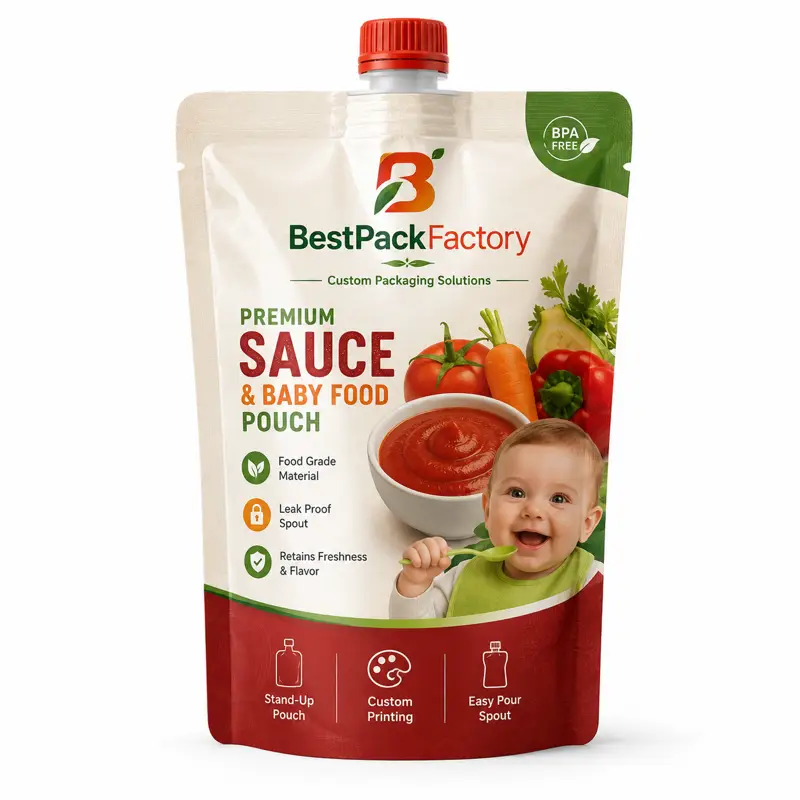
Pick the spout from the product, not from the pouch. Thin drinks and smooth baby purées commonly use a spout with an inner diameter of about 8.6–10 mm in the centre of the top seal; smoothies with pulp, yoghurt and pourable sauces usually move up to roughly 10–16 mm; thick condiments, chunky products and refill packs need about 16–22 mm or more, often in a corner position for controlled pouring. Children’s products should carry an oversized anti-choke cap. Treat these as starting points and confirm flow, sealing and filling on a physical sample.
Quick facts: Custom Spout Pouches
- Indicative unit price: about US$0.05–0.10 per piece. This is a guide, not a quotation: the final price depends on size, material, print colours, finish and order quantity.
- MOQ: typically from 500 pcs per size and artwork; the confirmed minimum depends on material, print method and features and is stated on the quotation.
- Lead time: Physical samples 5–7 working days after artwork is confirmed; bulk production 20–30 days after sample approval.
- Who makes it: BestPackFactory’s own factory in Longhua District, Shenzhen, China. Free dieline and artwork proof within 24 hours. See real samples and videos.
- Specifications and quote: Custom Spout Pouches · Request a quote
Why spout size is a product decision
A spout pouch is a pouch body plus a moulded fitment: the spout (with a welded base, sometimes called the boat or canoe), and a cap. The pouch format and laminate get most of the attention in a brief, but the spout bore decides how the product leaves the pack. Too narrow and a thick sauce needs hard squeezing, pulp blocks the opening, and the line fills slowly if the pack is filled through the spout. Too wide and a toddler gets a mouthful at once, a thin drink glugs and splashes, and the welded base takes up more of the top seal. This guide covers only the spout itself: bore, position, cap and the process limits that go with them. For choosing the pouch body shape, see our pouch format comparison.
Starting points by product
The inner diameters below are the ranges most commonly seen in the market. Spout catalogues differ by a millimetre or two, so confirm the exact bore on the fitment drawing and test flow on a sample.
| Product | Typical spout inner diameter | Typical position | Cap notes |
|---|---|---|---|
| Water, juice, sports and energy drinks | about 8.6–10 mm | Centre | Screw cap with tamper-evident band |
| Smooth baby food purée | about 8.6–10 mm | Centre | Oversized anti-choke cap with tamper band |
| Smoothies, yoghurt, purées with fine pulp | about 10–16 mm | Centre | Screw cap; check pulp does not bridge |
| Ketchup, mayonnaise, dressings, honey | about 10–16 mm | Centre or corner | Screw cap or flip cap; a valve can reduce drips |
| Chunky sauces, soups, fruit pieces, drinks with jelly or pearls | about 16–22 mm, sometimes larger | Centre or corner | Wide screw cap |
| Refill packs (soap, detergent, oil) | about 16–33 mm | Corner, often angled | Wide screw cap; pour into the target bottle |
Decision rules
- Size for the largest piece. If the product contains pieces, make the spout inner diameter at least two to three times the largest particle, then test. Fibrous or sticky pieces can still bridge, so the sample test is the real check.
- Size for viscosity. Thin liquids flow well through 8.6–10 mm. Thick products need a wider bore or the consumer has to squeeze hard and the pack collapses unevenly. If the product is filled through the spout, a wider bore also helps filling speed.
- Choose centre for drinking and squeezing. A centre spout keeps the pack balanced in the hand and suits juice, baby food and products eaten directly from the pouch.
- Choose corner for pouring. A corner spout, often set at an angle, gives a controlled stream and lets the pouch empty more completely when tilted. It suits sauces, oils and refills.
- Think about the consumer. For children’s products, an oversized anti-choke cap is the common choice. For products sold to adults on the go, a tamper-evident band and a cap that is easy to grip matter more.
- Match the process. Spouts are commonly moulded in PE or PP. The spout material must weld to the pouch sealant, and both must handle your filling or heat treatment. Hot-fill and retort applications typically pair PP fitments with a PP-based sealant, but always confirm ratings with the specific fitment.
Spout position and pouch size work together
The welded base of the spout needs a flat section of top seal. On a small pouch, a large spout can leave very little seal on either side, which raises the risk of leaks at the base. As a rough guide, the wider the bore, the wider the pouch you need to keep a comfortable seal margin. If a small pack needs a wide spout, a corner position is often easier to seal than a centre one. Ask the supplier to show the spout on the dieline before artwork starts, because the fitment also hides part of the top panel.
Cap and closure options
- Standard screw cap with tamper band: the default for drinks and most food.
- Anti-choke cap: a larger cap designed so a small child cannot swallow it; standard practice for baby and toddler food.
- Flip or disc cap: one-handed dispensing for condiments.
- Silicone valve insert: used in some sauce spouts to cut drips and stop flow when squeezing stops.
- Child-resistant cap: available for some non-food refills; confirm whether your market requires it and how it is tested.
Cap colour can usually be chosen from a standard range; custom colours are confirmed in the quotation.
What to send in your RFQ
- Product name, viscosity description (water-like, yoghurt-like, paste) and largest particle size.
- Fill volume or weight and the target pouch size, if you have one.
- Filling method: through the spout, or through an open top or bottom before sealing.
- Fill temperature and any heat treatment (cold fill, hot fill, pasteurisation, retort) with temperature and time.
- Preferred spout bore, position (centre or corner) and cap type, or ask for a recommendation.
- End user: infants, children, adults, or industrial refills.
- Barrier and shelf-life needs, transparency or window requirements.
- Quantity per design and artwork status.
Common mistakes
- Copying the spout size of a competitor product with a different recipe. Pulp level and viscosity change the answer.
- Choosing a 22 mm spout on a small pouch and leaving too little seal margin around the fitment.
- Forgetting that a spout rated for cold fill may soften or distort in hot fill or retort.
- Testing flow with water instead of the real product at its real serving temperature.
- Approving artwork before the spout position is fixed on the dieline, so text sits under the fitment.
Sample test before you order
Fill sample pouches with your actual product, cap them as the line will, and check: flow when squeezed and poured, whether pieces block the bore, leaks at the spout base after a drop and a squeeze test, cap removal force, and tamper band behaviour. If the pack will be heat treated, run the samples through your process before approving. Lock the approved spout drawing and cap into the purchase order.
Frequently asked questions
What spout size is used for baby food pouches?
Smooth baby food purées commonly use a spout with an inner diameter of about 8.6–10 mm in the centre of the pouch, closed with an oversized anti-choke cap. Purées with texture or small pieces may need a larger bore; confirm flow on a sample with your actual recipe.
Should a sauce pouch have a centre spout or a corner spout?
A corner spout usually gives a more controlled pour and lets the pack empty more completely when tilted, so it suits sauces, oils and refills. A centre spout suits products that are squeezed or drunk directly, such as juice and baby food.
How do I size a spout for a product with pieces?
A practical rule is to make the spout inner diameter at least two to three times the largest particle, then test. Fibrous or sticky pieces can bridge across an opening even when the size rule is met.
Can a spout pouch be hot-filled or retorted?
Only if the spout, cap and laminate sealant are all rated for that process. Spout material must also be compatible with the pouch sealant, so confirm the fill or sterilisation temperature in the RFQ and validate it on samples.
What is the MOQ for custom spout pouches?
At BestPackFactory the MOQ is 500 PCS per design. Spout size, cap style, structure and cost for your specification are confirmed in the quotation.
Related pages
Prepare a quote-ready packaging brief
Send your product type, viscosity or particle size, fill volume, filling method, fill temperature, spout position and cap style, quantity per design, artwork status and destination. Every product is made in BestPackFactory’s own factory and the MOQ is 500 PCS per design; specifications, documents and schedule are confirmed in the quotation. You can also reach Lisa on WhatsApp +86 158 8653 0985 or at lisa@colorprintingpackage.com.
Request a project quote