
Retort Pouch Structure for 121 °C vs 135 °C Sterilisation: Which Laminate Fits Your Ready Meal?
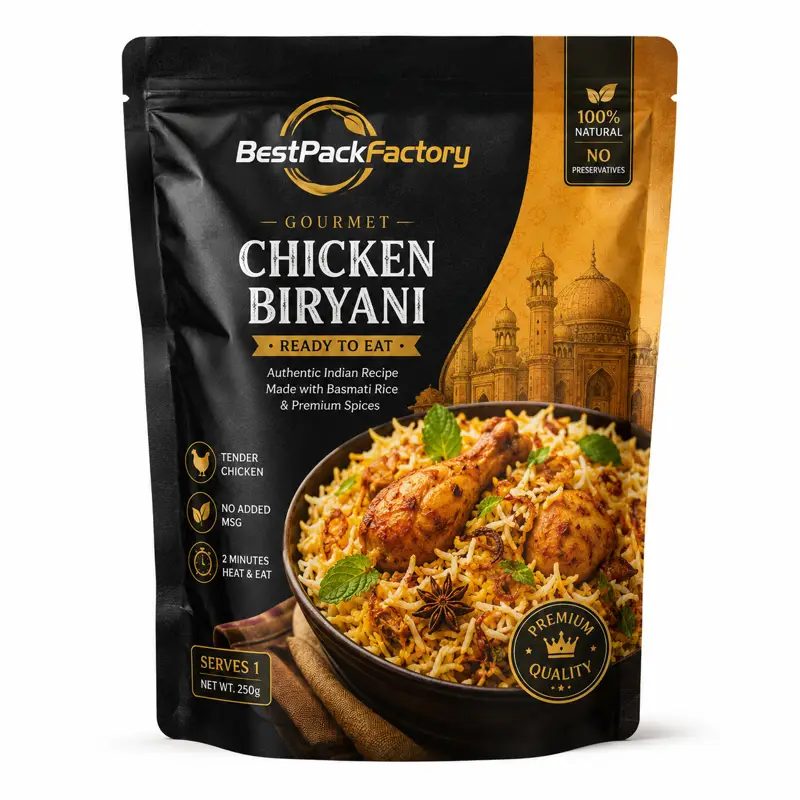
Quick answer
Start from your process, then pick the laminate. Most ready meals are retorted at around 121 °C, where foil structures such as PET/AL/RCPP, clear structures such as PET/PA/RCPP or AlOx-coated PET/PA/RCPP, and some mono-PP designs are commonly used. Processes around 130–135 °C call for a high-temperature retort sealant and, in most cases, a foil laminate with a nylon layer such as PET/AL/PA/RCPP. No laminate makes a process safe on its own: your thermal process must be validated by you or your process authority on filled pouches.
Quick facts: Custom Retort Pouches for Ready Meal Packaging
- Indicative unit price: about US$0.05–0.10 per piece. This is a guide, not a quotation: the final price depends on size, material, print colours, finish and order quantity.
- MOQ: typically from 500 pcs per size and artwork; the confirmed minimum depends on material, print method and features and is stated on the quotation.
- Lead time: Physical samples 5–7 working days after artwork is confirmed; bulk production 20–30 days after sample approval.
- Who makes it: BestPackFactory’s own factory in Longhua District, Shenzhen, China. Free dieline and artwork proof within 24 hours. See real samples and videos.
- Specifications and quote: Custom Retort Pouches for Ready Meal Packaging · Request a quote
The question this guide answers
Our flexible packaging structures guide explains what each film layer does. This article narrows that down to one decision: which retort laminate fits the sterilisation temperature, time and use of your product. It is written for brands and co-packers of ready meals, rice, curries, soups, pet food and similar shelf-stable foods.
Why temperature drives the structure
During retort, the sealed pouch sits in hot water or steam under pressure. Every layer, adhesive and ink must survive that heat without delaminating, blistering, shrinking or losing seal strength, and the sealant must not soften to the point that seals creep. A higher process temperature shortens the hold time needed, which can help taste and texture, but it narrows the list of materials that cope. In practice the market tends to talk about two bands: standard retort around 121 °C, and high-temperature retort around 130–135 °C. Hold times vary widely with the product, pouch thickness and retort type, so treat any time figure as illustrative.
Common retort structures compared
Layer thicknesses and ratings below are typical market descriptions, not a specification. Ask for the datasheet of the exact laminate quoted and confirm it on samples run through your own process.
| Structure | Typically rated for | Strengths | Watch-outs |
|---|---|---|---|
| PET / AL / RCPP | around 121 °C | Very high oxygen, moisture and light barrier; long ambient shelf life | Opaque; not for microwave; foil can crack with sharp contents |
| PET / AL / PA / RCPP | around 121 °C, and high-temperature grades up to about 135 °C | Foil barrier plus nylon for puncture and drop resistance | Opaque; not for microwave; higher material cost |
| PET / PA / RCPP (clear) | around 121 °C | Product visibility; tough | Much lower oxygen barrier than foil, so shorter shelf life |
| AlOx- or SiOx-coated PET / PA / RCPP | commonly around 121 °C; check the grade | Transparent barrier; can be microwaveable | Coating can crack if creased; barrier sits between clear and foil |
| Mono-PP retort designs | commonly around 121 °C | Designed for PP recycling where collected | Fewer options at high temperature; confirm barrier and seal strength |
Decision rules
- Process at about 121 °C and need the longest ambient shelf life: start with a foil laminate, PET/AL/RCPP or PET/AL/PA/RCPP.
- Process at about 130–135 °C: specify a laminate whose sealant, adhesive and inks are rated for that temperature. In most cases this is a foil and nylon structure with a high-temperature RCPP.
- Contents with bones, hard grains or sharp edges: add a nylon (PA) layer for puncture resistance and check drop performance.
- Consumers heat the pouch in a microwave: avoid foil; look at clear oxide-coated structures and confirm the grade, plus any steam vent or tear-notch design.
- Shelf visibility matters more than maximum shelf life: a clear or window structure can work, but run a storage study to confirm the shelf life it gives your product.
- Recyclability is a goal: ask what mono-PP options exist for your temperature, and test them side by side with your current pouch.
Who validates what
The pouch laminate is one input into a sterilisation process, not the process itself. The food manufacturer, usually with a recognised process authority, is responsible for heat-penetration studies, establishing the scheduled process, and proving the shelf life. A packaging supplier can provide laminate specifications, material compliance documents and help with sample trials. Do not rely on a laminate rating or a supplier statement as evidence that your product is commercially sterile; validate on filled, processed pouches with your own equipment and recipe.
What to send in your RFQ
- Product description, fill weight, fill temperature and whether pieces, bones or oil are present.
- Retort temperature, hold time and come-up time, plus retort type (water spray, water immersion, steam or steam-air) and whether overpressure is used.
- Required shelf life and storage conditions.
- Microwave use, window or full transparency, and any opening features such as a tear notch.
- Pouch format and size (flat, stand-up, gusseted) and fill method.
- Target markets so that food-contact documents can be requested for the right regulations.
- Quantity per design and artwork status.
Common mistakes
- Ordering a 121 °C laminate and then raising the retort to 135 °C to save cycle time without re-checking the materials.
- Choosing a clear pouch for display and assuming foil-level shelf life.
- Leaving too little headspace control or residual air, which can stress seals during retort.
- Printing heavy ink coverage in the seal area or using inks not rated for retort.
- Skipping a post-retort check of seal strength, delamination and appearance on the first production pouches.
Sample trial checklist
Fill samples with your real product, seal them on your line settings, and run them through your actual retort cycle. After processing, inspect for delamination, wrinkles, blisters and print damage, then test seal strength and burst resistance. Keep processed samples in storage for your shelf-life study. Only lock the laminate into the purchase order once these results are acceptable for your product and your process has been validated.
Frequently asked questions
Which retort pouch structure is used for 121 °C sterilisation?
Common 121 °C structures include PET/AL/RCPP, PET/AL/PA/RCPP, clear PET/PA/RCPP and AlOx-coated PET/PA/RCPP. The right one depends on barrier, transparency and microwave needs, and must be confirmed by testing with your product and process.
What changes for 135 °C retort?
Higher temperatures need a high-temperature retort-grade sealant, retort-grade adhesives and inks, and usually a foil laminate with a nylon layer for toughness. Many clear and mono-material structures are only rated around 121 °C, so confirm the rating of the exact laminate.
Can a retort pouch go in the microwave?
Foil laminates are generally not suitable for microwave heating. Clear structures with an oxide-coated barrier film are commonly used for microwaveable retort pouches, but confirm the specific laminate and add usage instructions on the pack.
Does the pouch supplier validate my sterilisation process?
No. The supplier can provide laminate specifications and support sample trials, but the thermal process, its lethality and the shelf-life claim must be validated by the food manufacturer or its process authority on filled, processed pouches.
What is the MOQ for custom retort pouches?
At BestPackFactory the MOQ is 500 PCS per design. The structure, documents and cost for your specification are confirmed in the quotation.
Related pages
Prepare a quote-ready packaging brief
Send your product, fill weight, retort temperature and time, retort type, heating medium, microwave or window requirement, shelf-life target, quantity per design, artwork status and destination. Every product is made in BestPackFactory’s own factory and the MOQ is 500 PCS per design; specifications, documents and schedule are confirmed in the quotation. You can also reach Lisa on WhatsApp +86 158 8653 0985 or at lisa@colorprintingpackage.com.
Request a project quote