
Roll Stock Film Spec Sheet: What to Give Your Supplier for VFFS and HFFS Machines
Quick answer
Give the supplier your machine make and model and a one-page spec covering: film structure and thickness, web width, repeat (cut-off) length, core inner diameter, maximum roll outer diameter or weight, eye mark size, colour and position, unwind direction diagram, seal type (fin or lap) and sealing window, and splice limits. Most of these values come from your packing machine and its forming set, so take them from the machine manual or the machine supplier and confirm them with a test roll.
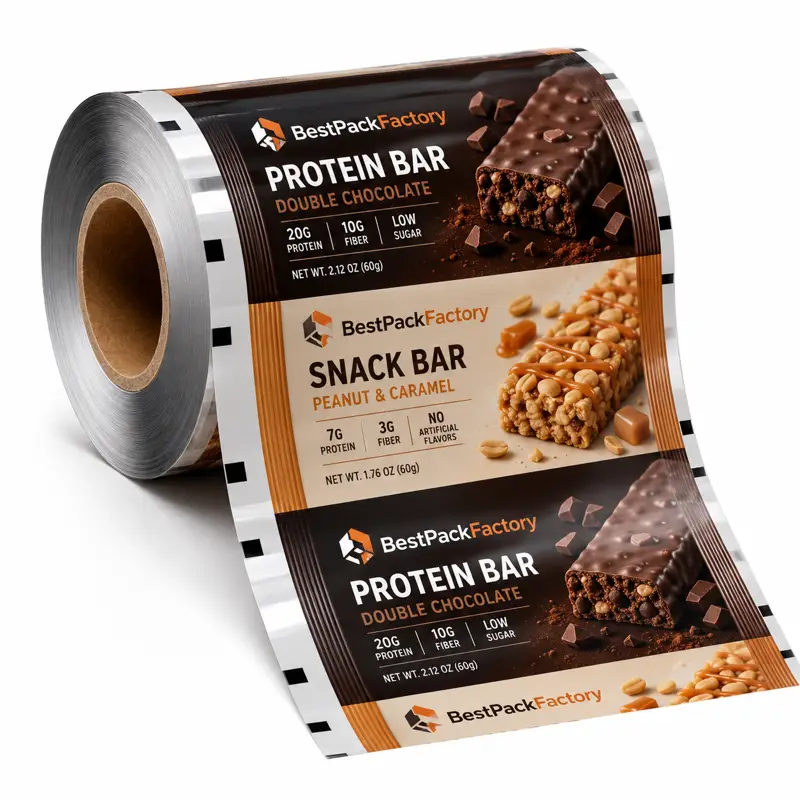
Quick facts: Custom Roll Stock Film for Snack & Protein Bar Packaging
- Indicative unit price: about US$0.05–0.10 per piece. This is a guide, not a quotation: the final price depends on size, material, print colours, finish and order quantity.
- MOQ: typically from 500 pcs per size and artwork; the confirmed minimum depends on material, print method and features and is stated on the quotation.
- Lead time: Physical samples 5–7 working days after artwork is confirmed; bulk production 20–30 days after sample approval.
- Who makes it: BestPackFactory’s own factory in Longhua District, Shenzhen, China. Free dieline and artwork proof within 24 hours. See real samples and videos.
- Specifications and quote: Custom Roll Stock Film for Snack & Protein Bar Packaging · Request a quote
Why roll stock needs a machine-first spec
Pre-made pouches are checked against a drawing. Roll stock is different: the printed film is formed, filled and sealed on your own machine, so the film has to match that machine’s forming set, sensor, unwind and sealing jaws. A beautiful print that is 5 mm too wide, wound the wrong way or carrying an eye mark the sensor cannot see will stop the line. VFFS (vertical form-fill-seal) machines are typical for snacks, powders and granules; HFFS or flow-wrap machines are typical for bars, biscuits and single items. The spec sheet below works for both. If you are buying labels on rolls instead of film, our roll label winding checklist covers that case.
The spec sheet
Values marked “typical” vary by machine. Use your machine’s figures and confirm them on a test roll.
| Parameter | What to state | Where it comes from |
|---|---|---|
| Machine | Make, model, VFFS or HFFS, bag style (pillow, gusseted, block bottom, flow wrap) | Your line |
| Film structure | Layers and thickness, for example OPP/CPP or PET/VMPET/PE; total thickness in microns | Product barrier needs and machine sealing |
| Web width | Finished width in mm with tolerance | Bag width plus seal allowance, from the forming set |
| Repeat (cut-off) length | Print repeat in mm with tolerance | Bag length including seals |
| Core | Inner diameter (commonly 76 mm or 152 mm), material, width | Unwind shaft |
| Roll size limit | Maximum outer diameter and/or maximum roll weight | Unwind and handling limits |
| Eye mark | Size, colour, background, position on the repeat | Registration sensor |
| Unwind direction | Numbered diagram: print outside or inside, head or foot leading | Film path through the machine |
| Seal type and window | Fin or lap; jaw temperature range, dwell time if known | Machine jaws and speed |
| Coefficient of friction | Target range for film-to-film and film-to-metal, if specified by the machine supplier | Forming collar and tube |
| Splices | Maximum splices per roll, splice tape colour and marking | Line tolerance |
| Packing | Rolls per pallet, wrapping, core plugs, label content | Your warehouse |
Web width and repeat length
On a VFFS pillow bag, the film wraps around a forming tube and is sealed lengthwise at the back. A rough calculation is: web width ≈ 2 × bag width + seal allowance. For a fin seal the allowance is two fin widths, often around 10 mm each; for a lap seal it is the overlap, often in the 10–15 mm range. Gusseted and block-bottom bags need extra width for the gussets. The repeat length equals the finished bag length including top and bottom seals. These are approximate; the forming set defines the real figure, so ask your machine supplier for the web width they built the tube for. On HFFS flow-wrap the logic is similar, with the bag wrapping around the product instead of a tube.
Eye mark and registration
- One eye mark per repeat, printed in a solid, dark colour on a light, clean background, or as your sensor requires.
- Commonly a rectangle a few millimetres along the web and roughly 10 mm or more across; confirm the size with your sensor range.
- Keep a clear lane across the web around the mark so no other artwork triggers a false read.
- Position it where the sensor sits, often near the cut-off or seal, so it ends up in the seal area or a non-display zone.
- For clear or metallised films, confirm the sensor can read the contrast; a white backing behind the mark often helps.
Unwind direction and print side
Write the direction on a numbered diagram, not in words. State whether the printed face is outside or inside the roll and whether the top or bottom of the design comes off the roll first. Most laminated films are reverse printed on the outer film and buried in the laminate, so the print looks correct from the outside of the bag. Send a photo of the current roll on your machine if you are switching suppliers.
Fin seal or lap seal
A fin seal joins the inside surface to the inside surface and works with most laminates. A lap seal overlaps the edges and joins the inside surface to the outside surface, which saves some film but needs both surfaces to seal together, so the structure has to be designed for it. Tell the supplier which one your machine uses before the structure is chosen.
Choosing the print process
Long runs of roll stock are often printed by rotogravure, while shorter runs and test rolls may be printed digitally. The trade-offs are covered in our guide to digital vs rotogravure printing for flexible packaging.
Common mistakes
- Quoting the bag width instead of the web width.
- Sending artwork without the eye mark, or placing text inside the eye mark lane.
- Ordering rolls larger or heavier than the unwind can hold.
- Choosing a film for barrier alone and finding it will not seal at the line speed.
- Skipping a test roll before a full run.
Run a test roll
Before the full order, run a short roll on the real machine at production speed. Record tracking, registration, seal integrity, leakers, the cut position against the print and any static or slip problems. Once it runs well, write the approved width, repeat, core, roll size, eye mark and unwind into the purchase order so every repeat order matches.
Frequently asked questions
How do I calculate web width for a VFFS pillow bag?
For a fin seal, web width is roughly twice the bag width plus two fin allowances. For a lap seal, it is roughly twice the bag width plus the overlap. Confirm the allowance with your forming tube supplier, because the forming set determines the final value.
What core size is used for roll stock film?
Packing machines commonly take a 76 mm (3 inch) core, and some larger machines use 152 mm (6 inch). Check your machine manual and state the core inner diameter and material in the RFQ.
Where should the eye mark be placed?
The eye mark is usually printed once per repeat in a solid, high-contrast colour, in a clear lane near the cut or seal area where the machine sensor reads it. Your machine supplier should confirm size, position and colour against the sensor.
Can a lap seal be used with any film?
No. A lap seal bonds the inside of the film to the outside, so both surfaces must seal to each other. Fin seals bond inside to inside and work with most laminates.
What is the MOQ for custom printed roll stock film?
BestPackFactory’s MOQ is 500 PCS. How that applies to a roll stock order, and the roll specification, structure and cost for your line, are confirmed in the quotation.
Related pages
Prepare a quote-ready packaging brief
Send your machine make and model, bag dimensions, web width, repeat length, core and roll limits, eye mark details, unwind diagram, seal type, product and fill weight, quantity and artwork status. Every product is made in BestPackFactory’s own factory and the MOQ is 500 PCS per design; specifications, documents and schedule are confirmed in the quotation. You can also reach Lisa on WhatsApp +86 158 8653 0985 or at lisa@colorprintingpackage.com.
Request a project quote