
O-Ring vs D-Ring vs Slant-D Binder: Which Ring Type and Size Holds Your Sheets, Tabs and Sheet Protectors
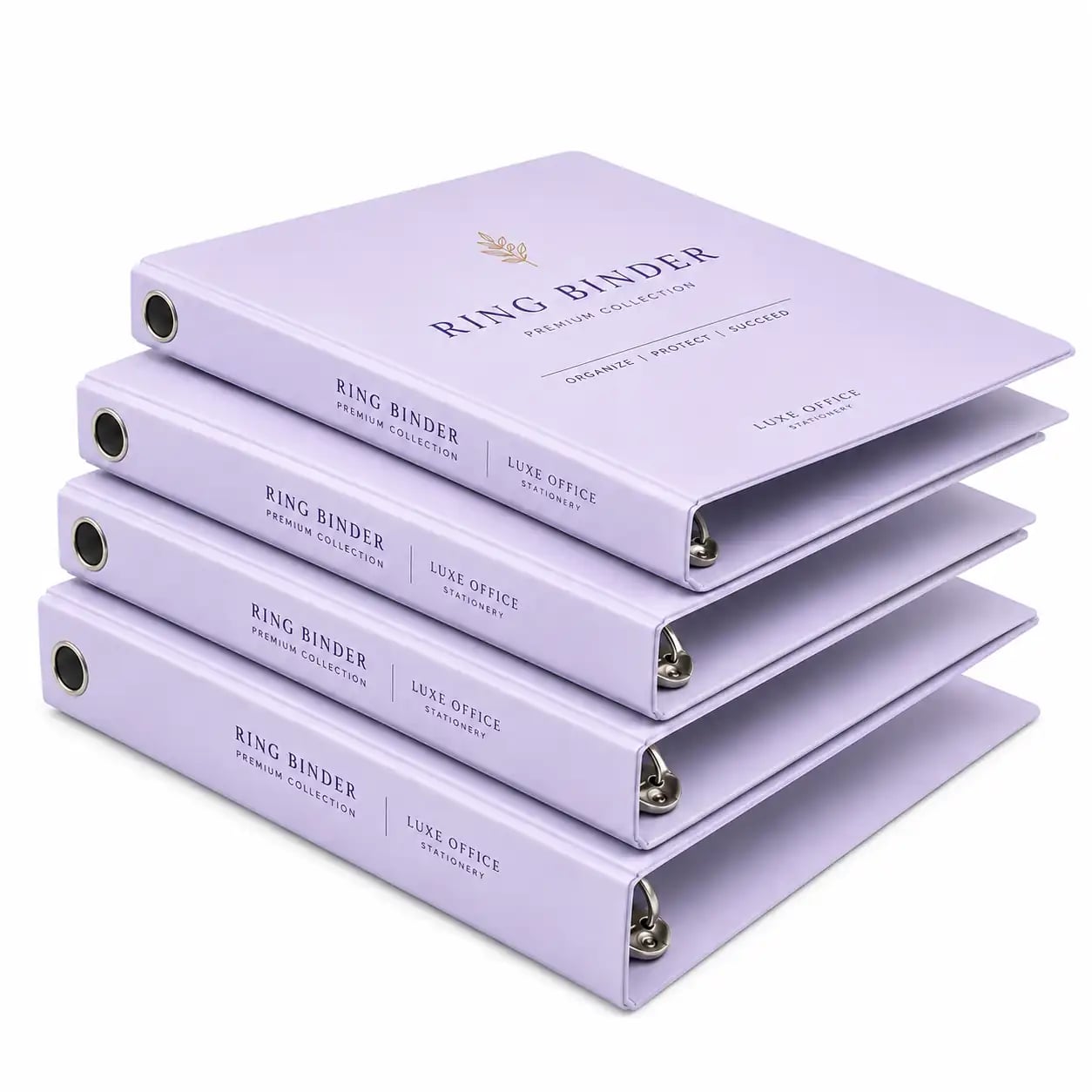
Quick answer
Count everything that goes on the rings, convert tabs and sheet protectors into sheet equivalents, then pick a ring that is only about 75–80% full. O-rings are the economical choice for small, lightly used sets. D-rings typically hold roughly a quarter to a half more than an O-ring of the same nominal size and keep pages flat and aligned, so they suit thick manuals and reference binders. Slant-D rings sit between the two in capacity and are favoured for frequent page turning. As a typical guide, a 1 inch (about 25 mm) ring holds about 175 sheets of 75–80 gsm paper as an O-ring and roughly 220–275 sheets as a D or slant-D ring; confirm with a filled sample.
Quick facts: Custom PP Ring Binder Folders
- Indicative unit price: about US$0.40–1.50 per printed PP ring binder at 500 pcs; multi-ring, zip or thicker PP binders sit at the top of the range. This is a guide, not a quotation: the final price depends on size, material, print colours, finish and order quantity.
- MOQ: typically from 500 pcs per size and artwork; the confirmed minimum depends on material, print method and features and is stated on the quotation.
- Lead time: Physical samples 5–7 working days after artwork is confirmed; bulk production 20–30 days after sample approval.
- Who makes it: BestPackFactory’s own factory in Longhua District, Shenzhen, China. Free dieline and artwork proof within 24 hours. See real samples and videos.
- Specifications and quote: Custom PP Ring Binder Folders · Request a quote
How the three ring shapes differ
An O-ring (round ring) is usually fixed to the spine. Pages curve around the ring, so the stack fans out and the effective capacity is lower. A D-ring has one straight side and is normally mounted on the back cover, so the pages stack squarely against the flat edge and lie flatter when open. A slant-D (angle-D) ring is also back-mounted but leans toward the spine, which many users find easier for turning pages in large sets. The nominal ring size, such as 1 inch or 25 mm, describes the ring diameter, not the number of sheets, which is why the same nominal size holds different amounts in each shape.
If you have not yet decided whether a binder is the right format at all, compare it with saddle stitch, perfect binding and wire-o in our book, catalogue and manual binding guide. This article assumes you have chosen a ring binder and now need the right ring.
Typical sheet capacity by ring size
| Nominal ring size | O-ring | Slant-D ring | D-ring |
|---|---|---|---|
| 0.5 in (about 13 mm) | about 75–100 sheets | about 100 sheets | about 100–125 sheets |
| 1 in (about 25 mm) | about 175–200 sheets | about 220 sheets | about 225–275 sheets |
| 1.5 in (about 38 mm) | about 250–300 sheets | about 375 sheets | about 350–400 sheets |
| 2 in (about 50 mm) | about 350–400 sheets | about 500 sheets | about 450–500 sheets |
| 3 in (about 75 mm) | about 500–600 sheets (O-rings this large are less common) | about 650 sheets | about 600–700 sheets |
Ranges are typical published figures for plain 75–80 gsm (20 lb bond) office paper and vary between mechanisms and brands. Heavier paper, coated stock, tabs and sheet protectors reduce the count. Always confirm with a filled sample.
Convert tabs and sheet protectors into sheet equivalents
The table only works if you count your real contents, not just pages. A practical method:
- Plain pages: count leaves, not printed sides. A 200-page double-sided document is 100 sheets.
- Heavier paper: for 100–120 gsm stock, allow roughly 1.3–1.6 times the space of standard copy paper; for cover-weight inserts, count each as several sheets.
- Tab dividers: plastic or heavy card dividers are thicker than paper; as a working estimate, count each as about 2–5 sheets depending on material.
- Sheet protectors: each pocket plus its page commonly takes the space of roughly 2–4 plain sheets, depending on film thickness.
- Add headroom: divide the total by 0.75–0.8 so pages turn freely and holes do not tear. Then pick the smallest ring that covers the result.
Worked example: 300 sheets of copy paper, 10 plastic tabs (about 40 sheet equivalents) and 20 sheet protectors (about 60) give roughly 400 sheet equivalents. Divided by 0.75 for headroom, you need capacity for about 530, which points to a 3 inch D-ring or slant-D ring; a 2 inch D-ring would be overfilled. These are estimates; fill a sample to check.
Decision rules
- Under about 150 sheets, used occasionally: an O-ring is usually enough and keeps the binder slim and lower in cost.
- Thick manuals, catalogues and training binders: choose a D-ring; it holds more at the same size and pages stay aligned.
- Reference sets that are flipped through all day: consider a slant-D for easier turning.
- Many sheet protectors or tabs: go one ring size up from your plain-paper calculation, and prefer a D-ring so pockets do not bunch at the spine.
- Binders shipped full or carried daily: ask for a locking or one-touch mechanism so rings do not spring open, and check the gap where ring halves meet; a misaligned ring snags pages.
- Content that changes often: a binder is the right format; if pages are fixed, a bound printed catalogue may be cheaper per copy.
Match the mechanism to the paper and hole pattern
Ring count and spacing must match the punched holes. US Letter documents commonly use a 3-ring pattern with centres about 108 mm (4.25 in) apart. A4 documents commonly use 2-ring or 4-ring patterns; the 2-hole pattern with 80 mm spacing is defined in ISO 838. Confirm the hole pattern before artwork is finalised, because a binder made for one pattern will not take pages punched for another. Also note that the cover must be larger than the page size, and the spine width grows with the ring size; the exact cover and spine dimensions are fixed on the dieline.
What to send in your RFQ
- Page size (A4, Letter or custom) and hole pattern (2, 3 or 4 holes, spacing)
- Sheet count, paper weight, number of tabs and sheet protectors
- Preferred ring shape and size, or ask us to recommend one from your counts
- Cover material and printing, inside pockets, business-card slots or spine label
- Whether you also need printed inserts or a printed manual to go inside
- Quantity per design and delivery country
Formats are shown on our custom PP ring binder folders page; mechanism and cover specifications are confirmed in the quotation.
Common mistakes
- Choosing ring size from page count without counting tabs and sheet protectors.
- Filling a ring to 100%, which makes pages tear at the holes and rings gape.
- Assuming a 1 inch O-ring and a 1 inch D-ring hold the same amount.
- Ordering an A4 binder for Letter pages, or a 3-ring binder for 4-hole punched paper.
Frequently asked questions
Does a D-ring hold more than an O-ring?
Yes. At the same nominal ring size, a D-ring typically holds roughly 25 to 50 percent more sheets than an O-ring because the pages stack against the straight side instead of curving around the ring.
How many sheets fit in a 1 inch binder?
As a typical guide, about 175 to 200 sheets of standard 75 to 80 gsm paper with an O-ring and about 220 to 275 sheets with a slant-D or D-ring. Tabs, sheet protectors and heavier paper reduce this.
How full should a ring binder be?
Plan for about 75 to 80 percent of the rated capacity so pages turn freely, holes do not tear and the rings close properly.
What is the MOQ for custom printed ring binders?
At BestPackFactory the MOQ is 500 PCS per design. Cover material, mechanism and printing details are confirmed in the quotation.
Related pages
Prepare a quote-ready brief
Send the page size, hole pattern, sheet count and paper weight, number of tabs and sheet protectors, cover requirements, quantity per design and delivery country. Every BestPackFactory product is made in our own factory, and the MOQ is 500 PCS per design; specifications, documents and schedule are confirmed in the quotation. You can also reach Lisa on WhatsApp +86 158 8653 0985 or at lisa@colorprintingpackage.com.
Request a project quote