
Custom Book Printing
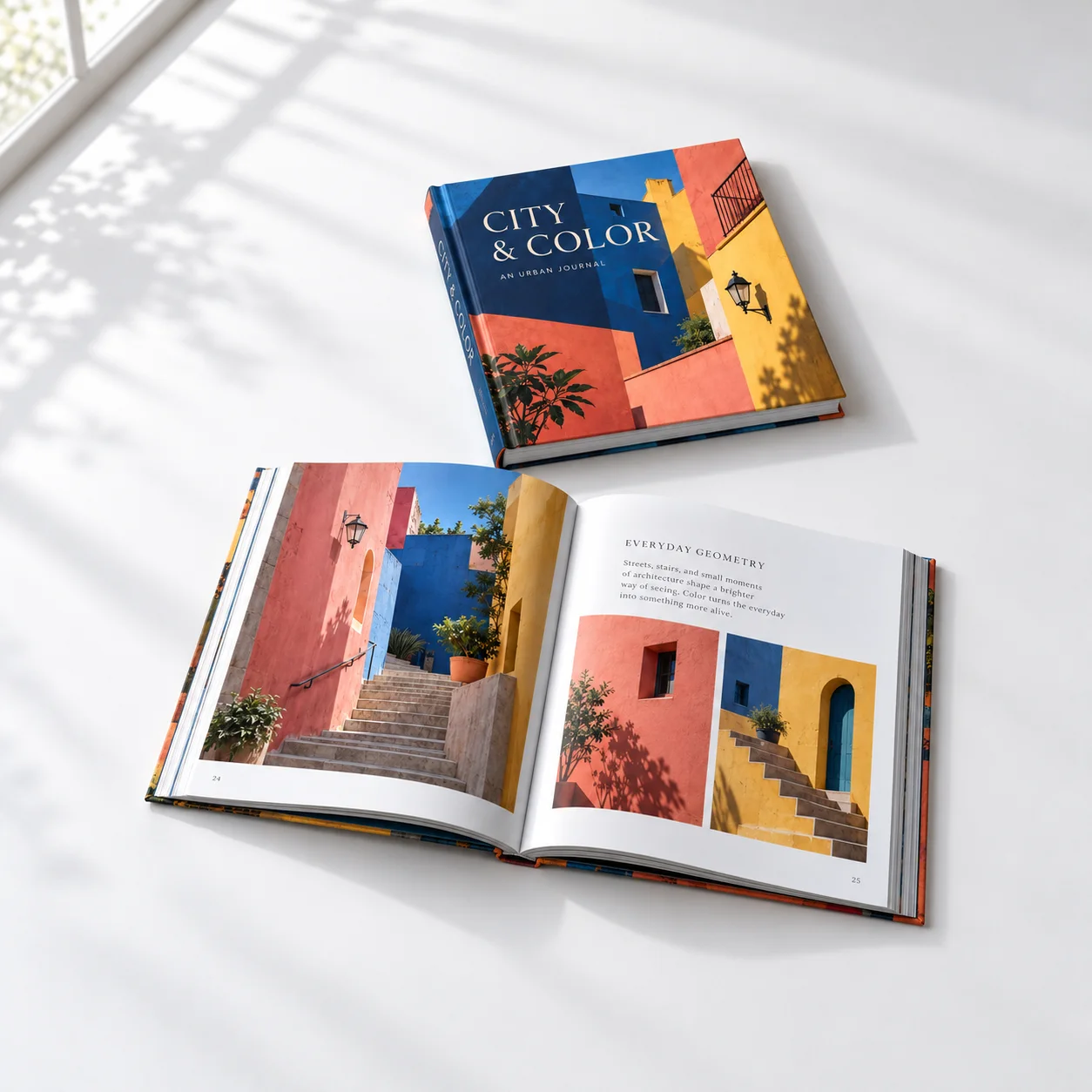
AI-generated printed-product concept, not an actual product photograph or customer case. Sample branding is illustrative; materials, construction and availability require confirmation.
Printed books for brands, companies, institutions and independent authors who need bound, long-form content in quantity: art and photo books, cookbooks, company histories, yearbooks, coffee-table books, novels and gift editions. This page covers the book as a printed and bound object. It is a printing service, not publishing, editing, ISBN registration or distribution. The difference from our other printed products is the reader: a book is read from cover to cover and kept, a catalog sells a product range (see custom catalog printing) and a manual explains a product it ships with (see custom manual printing). Binding methods are compared once, in the book, catalog and manual binding guide.
Custom Book Printing — Buyer Summary: key points
- Copyright clearance for the content and final proofreading remain with the buyer; we print the approved files.
Hardcover vs Paperback and Other Book Specifications
This comparison explains options commonly used in the market; it is not a list of what is fixed for your order. Paper, binding, finish and the final specification for your order are confirmed in the quotation and on samples.
| Hardcover (case binding) | The text block is bound and cased into rigid boards covered with printed paper or cloth, usually with endpapers and sometimes a dust jacket. Chosen for art books, gift editions and books expected to stay on a shelf for years. Heavier and more costly than a paperback. |
|---|---|
| Paperback (perfect binding) | Pages are glued at the spine into a flexible wrap-around cover. Common for text-heavy books, reports and lower-cost editions. The book needs enough pages to form a spine that can carry the title. |
| Thin and lay-flat books | Saddle stitch suits thin books such as activity books and short editions; wire-o or spiral lets workbooks and cookbooks lie flat. See the binding guide before you choose. |
| Trim size and page count | Books are printed in sections called signatures, so the total page count is often rounded to suit them. Spine width follows from page count and paper thickness; see how to calculate spine width and page count. |
| Cover and text pages | Cover and inside pages are specified separately: paper, printed colors and cover finish. Mixing color and black-and-white sections is a common way to manage cost in long books, and it works best when color pages are grouped by signature. |
| Proofing | A digital proof checks content and layout, a blank dummy shows thickness and how the book opens, and a printed proof checks color. See the proof types guide to decide which you need. |
Boxes that hold a book, such as our keepsake gift boxes, are packaging products and are quoted separately from the printed book.
What to Send for a Book Printing Quotation
A complete RFQ lets us quote the item you actually intend to buy. Items marked "confirmed in quotation" are not fixed on this page.
| Book type and use | Art book, cookbook, novel, yearbook, corporate history or other; gift, retail or internal use |
|---|---|
| Trim size | Finished width x height in mm, portrait, landscape or square |
| Page count | Pages inside the cover (one leaf printed both sides = 2 pages), and which pages are color or black only |
| Binding | Hardcover or paperback, or another binding you have in mind; confirmed in quotation |
| Cover | Printed colors, finish and extras such as a dust jacket or endpapers; confirmed in quotation |
| Text pages | Paper preference (coated, uncoated, thickness or feel); confirmed in quotation |
| Artwork | Print-ready PDF for the inside pages with bleed, and a separate cover file built to the confirmed spine width; see the print prepress checklist |
| Rights and proofreading | Buyer confirms rights to print the content and approves the final proof |
| Quantity and packing | Quantity per title or edition; carton packing and destination |
| MOQ | 500 PCS |
| Sampling and lead time | Confirmed in quotation per specification |
RFQ Checklist for Factory Quotation
- State the trim size, page count and how many pages are in color.
- Choose hardcover or paperback, or ask us to compare both.
- Send print-ready inside pages and the cover file once the spine width is confirmed.
- Tell us quantity, destination and which proofs you need before printing.
Custom Book Printing Questions
Should I choose hardcover or paperback?
Choose from how the book is used and kept. Hardcover protects the pages and suits art books, gift editions and books expected to stay on a shelf for years. Paperback is lighter and lower in cost, and suits text-heavy titles and books that are mailed or carried. Tell us the use, page count and quantity, and the binding for your order is confirmed in the quotation.
How do you count the pages of a book?
A page is one side of a leaf, so one sheet printed on both sides counts as two pages. Count every side inside the cover, including blank pages and title pages; the cover is specified separately. Books are printed in signatures, so the final page count may be rounded to suit them, and this is confirmed before the proof.
Can color and black-and-white pages be mixed in one book?
Mixing color and black-and-white sections is a common way to control cost in a long book. Where the color pages fall matters, because pages are printed in signatures; grouping color pages together is usually more efficient than scattering single pages. Send your page plan and the split for your book is confirmed in the quotation.
How is the spine width confirmed?
Spine width depends on the page count, the thickness of the text paper and the binding. It is calculated after the paper and page count are fixed, and then checked on a blank dummy or proof before the cover file is finalized. Build the cover to the confirmed spine width, not an early estimate.
Can I see a paper or binding sample before printing?
A blank dummy made with the proposed paper and binding shows thickness, weight, spine and how the book opens, while a printed proof shows color. Which samples are made for your order is confirmed in the quotation.
Click below to contact us quickly by WhatsApp or email. Send your trim size, page count, binding and quantity for a book printing quotation.
💬 Chat on WhatsApp ✉ Email Inquiry lisa@colorprintingpackage.com